

On weekday mornings across Britain, thousands of licensed taxis and private hire vehicles do not chase ranks or apps. They run fixed school routes for children who cannot get there any other way. That work sits inside a wider legal system called SEND — special educational needs and disabilities — and for the trade it is one of the biggest, most tightly controlled blocks of contracted work left in local government.
This feature sets out what SEND is, how home-to-school transport actually works, how the nations and councils differ, who pays, and what clearance drivers need before they take a child on board.
What SEND means
SEND is the English legal label for children and young people who need extra help because of a learning difficulty, disability, or both. The modern framework was rebuilt by the Children and Families Act 2014, which brought in Education, Health and Care (EHC) plans covering ages 0 to 25.
An EHC plan is not a bus ticket. Transport sits on a separate duty. In England, free home-to-school travel for eligible children of compulsory school age is rooted in section 508B of the Education Act 1996 and Schedule 35B, with detailed rules in the Department for Education’s statutory guidance, Travel to school for children of compulsory school age (updated May 2026).
Scotland talks about additional support needs (ASN), Wales about additional learning needs (ALN), and Northern Ireland still uses special educational needs (SEN). Families face the same everyday problem — getting a child to the right school safely — but each nation has its own statutes, distance rules and decision-makers.
How home-to-school SEND transport works

In England, parents are normally responsible for getting their child to school. The local authority must step in, free of charge, when a child is of compulsory school age, attends their nearest suitable school, and is “eligible”. Eligibility covers three main routes:
- the school is beyond the statutory walking distance — more than 2 miles for under-eights, more than 3 miles from age eight
- the child could not reasonably be expected to walk because of special educational needs, disability or a mobility problem, even if accompanied by a parent
- there is no reasonably safe walking route, even with accompaniment
There are also “extended rights” for some children from low-income households, with extra distance rules designed to support school choice.
Two points matter for taxi work. First, an EHC (Education, Health and Care) plan or a place at a special school does not automatically create a right to free transport. DfE guidance is explicit: eligibility on SEND grounds is assessed case by case. Second, the council chooses the arrangement. It might be a pass on a service bus, a dedicated school bus or minibus, a taxi or private hire vehicle, or — with parental consent — travelling expenses or what many authorities call a personal travel budget.
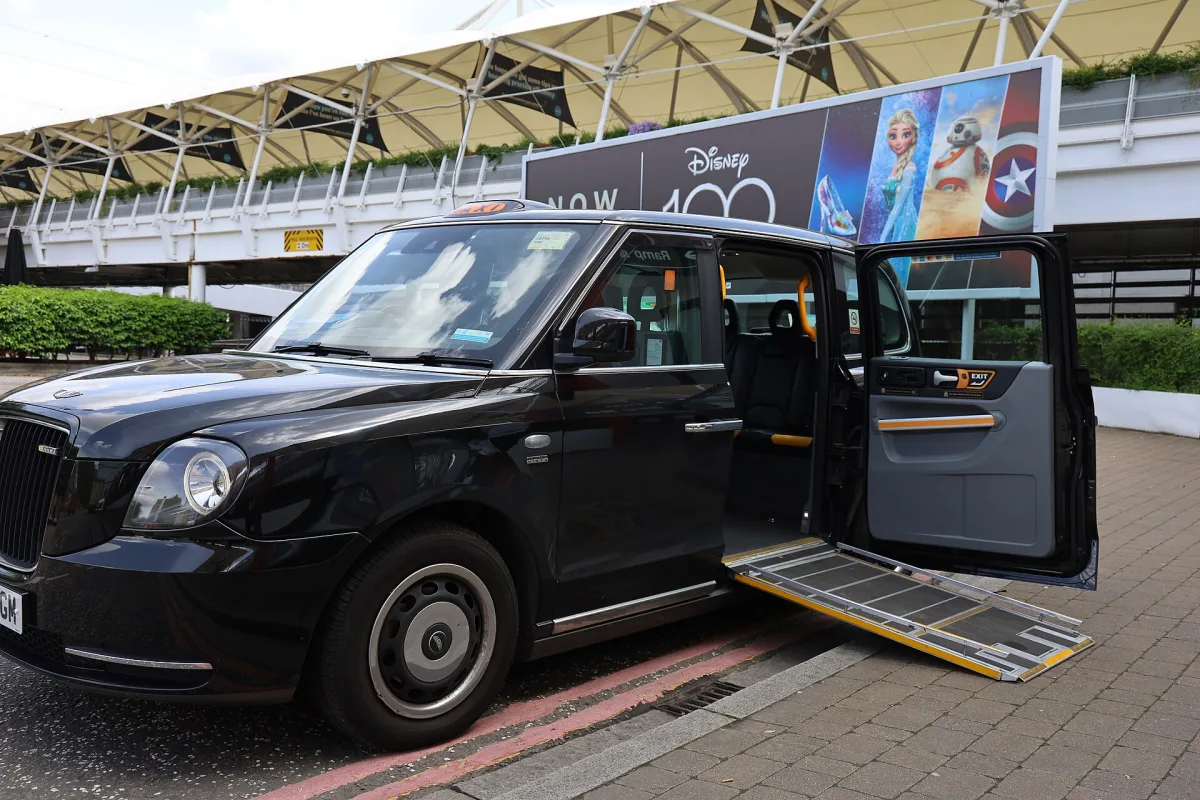
Passenger assistants (often called 'minders') ride with some children. Others need wheelchair-accessible vehicles, longer journeys to specialist settings, or single-occupancy cars where sharing is not safe. DfE’s first national collection estimated that about 9% of pre-16 SEND pupils on home-to-school transport travelled in single-occupancy vehicles (Explore education statistics, 2024/25).
Councils also have a discretionary power to help children who are not strictly eligible, and separate duties and policy statements for post-16 learners. That discretionary layer is where practice has been shrinking as budgets tighten.
Does it differ between councils — and nations?
Yes. England has one national statutory framework, but each local authority writes its own school travel policy, publishes it, and decides how to meet the duty. That is why two neighbouring counties can look alike on paper and feel very different to operators: different tender packs, different badge schemes, different training lists, different appetite for solo taxis versus shared routes.
Across the UK the split is sharper still:
- England — Education Act duties plus DfE statutory guidance; EHC plans under the 2014 Act
- Wales — the Learner Travel (Wales) Measure 2008, with ALN now sitting under the Additional Learning Needs system; free transport where distance thresholds are met or disability/learning difficulty means a child cannot walk even within those distances
- Scotland — local authorities must make necessary school transport arrangements under the Education (Scotland) Act 1980, with ASN considered under the additional support for learning laws; guidance stresses that transport need not be door-to-door
- Northern Ireland — SEN transport is arranged through the Education Authority, usually to the nearest suitable school, with taxis used only where necessary
Even inside England, rural authorities face longer specialist journeys; city authorities face denser demand and clean-air vehicle rules. The legal duty is shared. The map of contracts is local.
What it costs — and who pays
For eligible children of compulsory school age, the parent does not pay. The local authority pays. That bill has become one of the fastest-growing pressures in English local government.
The National Audit Office reported that in 2023–24 councils in England spent £2.32 billion transporting an estimated 520,000 children and young people aged 0–25. About £1.52 billion of that was for compulsory-school-age and younger children receiving transport because of SEND. Median annual cost per pupil was about £8,116 for SEND transport against £1,526 for mainstream transport — roughly five times higher. SEND transport spending rose 106% in real terms between 2015–16 and 2023–24, against 9% for mainstream. Authorities overspent their home-to-school transport budgets by £415 million in 2023–24.
DfE’s voluntary collection put pre-16 SEND transport users at around 180,000 of roughly 470,000 pre-16 pupils on local-authority transport. EHC plans themselves jumped from about 240,000 in January 2015 to 639,000 in January 2025, which helps explain why more children travel further to settings that can meet their needs.
Money comes from local-authority budgets, not a separate national SEND taxi fund. That is why councils push route sharing, independent travel training, in-house fleets and personal budgets — and why solo school runs are under constant scrutiny even when they remain necessary for some children.
Drivers, assistants and special clearance
Ordinary taxi or private hire work already demands a licensing authority “fit and proper” test. Department for Transport statutory taxi and PHV licensing guidance expects an enhanced DBS check with children’s and adults’ barred-list checks for driver licensing, plus Update Service registration in many areas.
Dedicated school transport goes further. DfE’s school-travel guidance says authorities should ensure that drivers and passenger assistants on dedicated school transport have had an enhanced DBS check with a children’s barred-list check, plus safeguarding training and a clear route for reporting concerns. Licensing DBS and school-contract DBS are not always treated as the same thing: some authorities and joint frameworks expect a further check framed for regulated activity with children, not only the “other workforce” taxi-licence check.
In practice, council tender packs commonly require some mix of:
- a current enhanced DBS, often for the child and adult workforce, with both barred lists clear
- subscription to the DBS Update Service
- a council or contractor ID badge worn on duty
- safeguarding and disability-awareness training, refreshed every few years
- wheelchair or PATS-style training where the route needs it
- right-to-work checks and, for assistants, separate clearance from the driver’s taxi badge
Examples are easy to find in operator guidance from authorities such as Derbyshire, Wokingham and West Berkshire. The exact badge, course provider and renewal cycle are local. Turning up with only a standard taxi licence is rarely enough.
Passenger assistants are not optional extras on many SEND routes. They need their own enhanced DBS and training. Drivers may also be asked to follow seating plans, radio-off rules, medication protocols in emergencies only, and handover routines with schools and parents.
Why it matters to the trade
SEND transport is not casual school-run work. It is regulated activity around vulnerable children, funded by councils under statutory duty, and increasingly managed for cost as well as care. For operators, that means multi-year tenders, clean-air vehicles, shared routes where possible, and paperwork that sits beside — and sometimes beyond — the local taxi licence.
For drivers, the opportunity is real: steady daytime miles, contracted payment, and work that keeps licensed vehicles at the centre of public service. The price of entry is clearance, training and the patience to do a specialist job properly.